
Business Skills
What Does ECG Stand For? Meaning & Importance in Healthcare

You know that moment at the doctor’s when they say, “We’re going to do an ECG,” and you’re sitting there thinking, “Hmm… what does ECG stand for?” It sounds technical, maybe even a bit scary.
But actually, it’s nothing to worry about. ECG stands for Electrocardiogram, which is just a test that checks how your heart is doing, how fast or slow it’s beating, and whether the rhythm is steady or not. It’s quick, totally painless, and super helpful for spotting any heart issues early. Want to know why doctors use it so often and what it can really tell you?
Here’s a detailed guide for you.

Table of Content
What Does ECG Stand for in Medical Terms?F
ECG stands for Electrocardiogram. It’s a simple and quick test that shows how your heart is working. Don’t worry, it doesn’t hurt at all. It’s one of the most common heart tests and can tell a lot about how healthy your heart is.
Now let’s break down what ECG really means:
- E stands for Electro, which means electricity. Your heart runs on tiny electrical signals that tell it when to beat.
- C stands for Cardio, which means heart. So we’re talking about the electricity in your heart.
- G stands for Gram, which means a written record or picture. The machine makes a drawing that shows how your heart is beating.
So, together, an electrocardiogram is a test that records the electrical signals in your heart. Its meaning how fast your heart is beating, whether it’s regular or not, and if anything unusual is going on.

Why is ECG Important in Healthcare?
Okay, think of your heart like a car engine. Sometimes, everything may seem fine from the outside, but inside, there could be little problems starting. You won’t always hear or feel them. That’s where an ECG comes in. It’s like plugging your heart into a system that checks if everything is running the way it should.
So, why do doctors often recommend or give importance an ECG? Let’s walk you through it in detail.
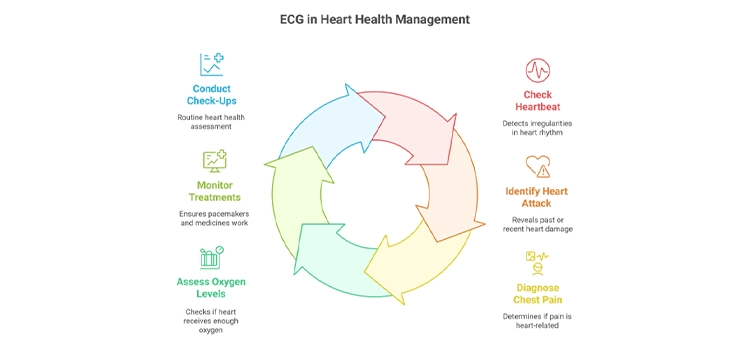
1. To Check If Your Heartbeat is Normal
One of the main uses of an ECG is to see if your heart is beating the way it should. Sometimes your heart might beat too slowly, too fast, or in an uneven way (this is called an arrhythmia). Even if you don’t feel it, the ECG can catch it and help your doctor figure out what’s going on.
2. To See If You Had a Heart Attack
If you’ve had a heart attack recently or even in the past, the ECG can show it. When part of your heart muscle gets damaged, it changes how the heart sends out electrical signals. The ECG can read those changes and tell the doctor which part of the heart was affected.
3. To Find Out Why You Have Chest Pain
Chest pain can be caused by many things, but the ECG helps doctors find out if the pain is coming from your heart. It can show if your heart’s blood vessels are blocked or if blood flow is too low. This helps in getting the right treatment quickly.
4. To Check If Your Heart is Getting Enough Oxygen
Sometimes, people feel short of breath, dizzy, or tired, and the reason might be that their heart isn’t getting enough oxygen. An ECG done during these symptoms can show if there’s a problem with oxygen reaching the heart, especially during stress or chest pain.
5. To Monitor Pacemakers or Heart Medicines
If you have a pacemaker or you’re taking medicines for your heart, the ECG can show if everything is working properly. It helps the doctor see if your pacemaker is keeping your heart in the right rhythm or if your medicines are helping or need to be changed.
6. To Do a Heart Health Check-Up
Even if you feel fine, an ECG is often done before surgeries or as a part of your regular check-up. It’s like a routine check to make sure your heart is in good shape and there’s nothing hidden going on inside.
Want to know which ECG test fits your situation? Check out the different types of ECG tests and their uses.

When Do Doctors Suggest an ECG?
You might need an ECG if you have symptoms like:
- Chest pain
- Skipping or fluttering heartbeat (palpitations)
- Shortness of breath
- Feeling dizzy or faint
- Tiredness or weakness for no reason
- High blood pressure
- Trouble exercising.
Even if you don’t feel anything unusual, your doctor might still recommend an ECG if:
- You have a family history of heart problems.
- You’re starting a new medicine that affects the heart.
- You’ve had heart surgery or treatments before.
How Does an ECG Work? What Happens During the Test?
Super simple process! Here’s what happens:
- You lie down on a bed.
- A nurse or technician attaches 10 small sticky pads (called electrodes) to your chest, arms, and legs.
- These pads are connected by wires to a machine.
- The machine records your heart’s electrical signals and prints a graph.
That’s it! It’s quick, safe, and painless.
Curious about what those waves and spikes mean? Learn the basics in our easy guide on how to read an ECG.
So, What Happens After an ECG?
Well, if your ECG looks normal, that’s great news. You might not need any more tests. But if the doctor sees something unusual in the results, they may want to look deeper.
They could suggest an exercise ECG, where you walk on a treadmill while your heart is being monitored to see how it reacts to movement. Another option is wearing a small device called a Holter monitor at home for 24 to 48 hours to track your heartbeat over a longer time.
If your symptoms come and go, they might give you an event monitor to wear for a few weeks, which records only when something unusual happens. In some cases, the doctor may also recommend an echocardiogram, which is basically an ultrasound scan of your heart that shows its shape and how it moves.
And if there’s a concern about blood flow or blockages, they might suggest a CT scan or a coronary angiogram to get a clear picture of your heart’s blood vessels. All of these follow-up tests help give a better understanding of what your heart needs.
Ever heard of a 12-lead ECG? It’s the standard way to get a full view of your heart. Read this guide to learn what it means.

New and Cool Developments in ECG
Technology is moving fast! Let’s talk about what’s new:
| New ECG Technology | What It Does |
| Wearable ECG T-shirts | Tracks heart rhythm while you’re active (like running or playing) |
| Mobile ECG devices (like smartwatches) | Record heart activity with just a tap when symptoms show up |
| Computer-assisted interpretation | The machine gives a second opinion by reading your ECG and spotting possible issues |
Important Note: While computers can help, doctors still review ECG results because machines can sometimes get confused by “noise” or poor electrode connection.
Thanks to new technology, even smartphones now help track heart health. Learn more in our guide on ECG apps.
Want to Learn ECG Skills the Right Way?
If you’re a healthcare professional, getting an ECG done the right way is really important. Even a small mistake while recording it can lead to missing a heart problem or giving the wrong diagnosis. That’s why learning how to do and read ECGs properly matters so much. It helps you spot heart issues early and gives better care to your patients.
If you want to learn how to read ECGs with real practice, our ECG Training Course is CPD Certified and covers everything from placing the electrodes to spotting unusual heart rhythms.
Join our ECG Interpretation Course and feel confident while working with ECGs.
Have any questions about ECG tests or the course? Just reach out. We’re happy to help!
Wrapping Up: When in Doubt, Get Checked
So, what does ECG stand for? An electrocardiogram is a test that might look small but gives big information about your heart. If you or someone you love ever experiences chest pain, palpitations, or breathlessness, don’t ignore it. A quick ECG could be the first step in finding out what’s going on.
Remember: Your heart works nonstop for you. Taking care of it starts with understanding it. And an ECG is one of the easiest ways to do that.
FAQs
1) Do I need to prepare for an ECG?
Not really. You don’t have to do anything special. Just wear loose clothes so it’s easy to place the sticky pads, and try to stay calm so the test gives the best results.
2) Will an ECG hurt?
Not at all. You might feel a bit of cold from the sticky pads or a tiny pinch when they’re taken off, but nothing painful.
3) Are there any risks regarding ECG?
ECG is a very safe test. Sometimes, a small number of people may get mild skin irritation where the pads were placed, but it usually goes away on its own.
4) What’s the difference between ECG and EKG?
There’s no difference at all. They both mean the same test. ECG is more common in the UK, while EKG is based on the German spelling “Elektrokardiogramm” and is used more in the US.
5) What does PQRST stand for in ECG?
In an ECG, PQRST is the pattern of waves that shows how your heart beats step by step. The P wave shows when the upper chambers of the heart (the atria) squeeze, the QRS part shows when the lower chambers (the ventricles) squeeze, and the T wave shows when the lower chambers relax and get ready for the next beat. It’s like watching your heart’s movement in slow motion through electrical signals.
6) What does aVR stand for in ECG?
aVR means augmented vector right. It’s one of the special views or angles from which the ECG looks at your heart, focusing on the upper right side.
7) What does EKG stand for?
EKG stands for electrocardiogram, just like ECG. The only difference is that EKG uses the German spelling “Elektrokardiogramm,” but they both mean the same test.